Ab Khurana
The Experimenter
· 41 min · Sales Executive · Based: Nomadic
Episode Description #
Ab Khurana treats his entire life as a series of experiments, including the experiment of having a normal life. Two years ago, the timing was right to settle, so he signed a lease in San Diego, built a routine, joined sports leagues, dated normally—all the standard stuff. Then, two years later, the timing was right to leave, so he left. Some people would call that a success. Some would call it a failure. Ab just calls it valuable experience.
He doesn’t theorise about what he wants. He runs experiments and observes the results. His framework: try ten things, you’ll love three, hate three, and feel neutral about four. But only once you’ve actually tried them, not just imagined them, will you know what to orient your life around. San Diego taught him he’s definitely a beach and sun person. That making new friends as an adult matters to him. That two years of routine felt good but not complete.
Now he’s pursuing the specific things his twelve-year-old self always wanted to do whilst the window is still open. Machu Picchu, check. Erupting volcano in Guatemala, check. Scuba diving certification despite being scared of water, check. Next up: the Galapagos Islands, a safari in Africa, a month on a farm with WWOOF making things with his hands instead of pushing pixels. And eventually, being a tourist in India, the country where he spent his first thirteen years but hasn’t visited since.
This is a masterclass in building self-knowledge through empirical living. When you stop predicting how you’ll feel and start collecting actual evidence, you stop wondering what you’ve missed and start knowing what matters. The tetherball metaphor applies: you can stray as far as you want, but you’re still tethered to something solid—whether that’s good parents, close friends, or the three things you’ve discovered you genuinely love. Trust your inner fire. It’s unique to you, and that’s the point.
Timestamps
- 00:00-00:39Introduction
- 00:39-02:00Guest introduction
- 02:00-02:50Two and a half years nomadic in two stints
- 02:50-05:04San Diego experiment, lease and routine
- 05:04-06:12Why he left, timing and freedom before commitments
- 06:12-07:00Long-term relationships and family considerations
- 07:00-07:46Twelve-year-old dreams and pursuing new experiences
- 07:46-09:38Maslow's hierarchy of needs discussion
- 09:38-12:34Fulfilling relationship needs through community
- 12:34-13:00Nomads more open and untethered from roles
- 13:00-13:29Only getting one layer deep, something missing
- 13:29-14:29Strengthening existing relationships
- 14:29-16:57Electron metaphor, travellers vs settled people
- 16:57-18:01Hopping on friends' trips, maintaining connections
- 18:01-19:32US vs Europe vacation time, 15 days vs 35 days
- 19:32-20:48Tetherball metaphor, being grounded whilst travelling
- 20:48-23:41Good parents as foundation, unconditional love
- 23:41-24:35Ten experiments framework, love 3, hate 3, neutral 4
- 24:35-25:55Self-awareness through experimentation
- 25:55-28:28Ibi's grounding, music and fire metaphor
- 28:28-29:44Inner fire, comparing to others leads to analysis paralysis
- 29:44-30:31Finding people who encourage your unique fire
- 30:31-36:05AI discussion, cultural shift and adaptation
- 36:05-36:53AI tinkerers, people who played the game before
- 36:53-38:26Recent adventures, Machu Picchu, volcano, scuba diving
- 38:26-40:33Future plans, Galapagos, safari, WWOOF, India as tourist
- 40:33-41:33Closing
Guest reflection
The Experimenter Who Builds Self-Knowledge Through Experience
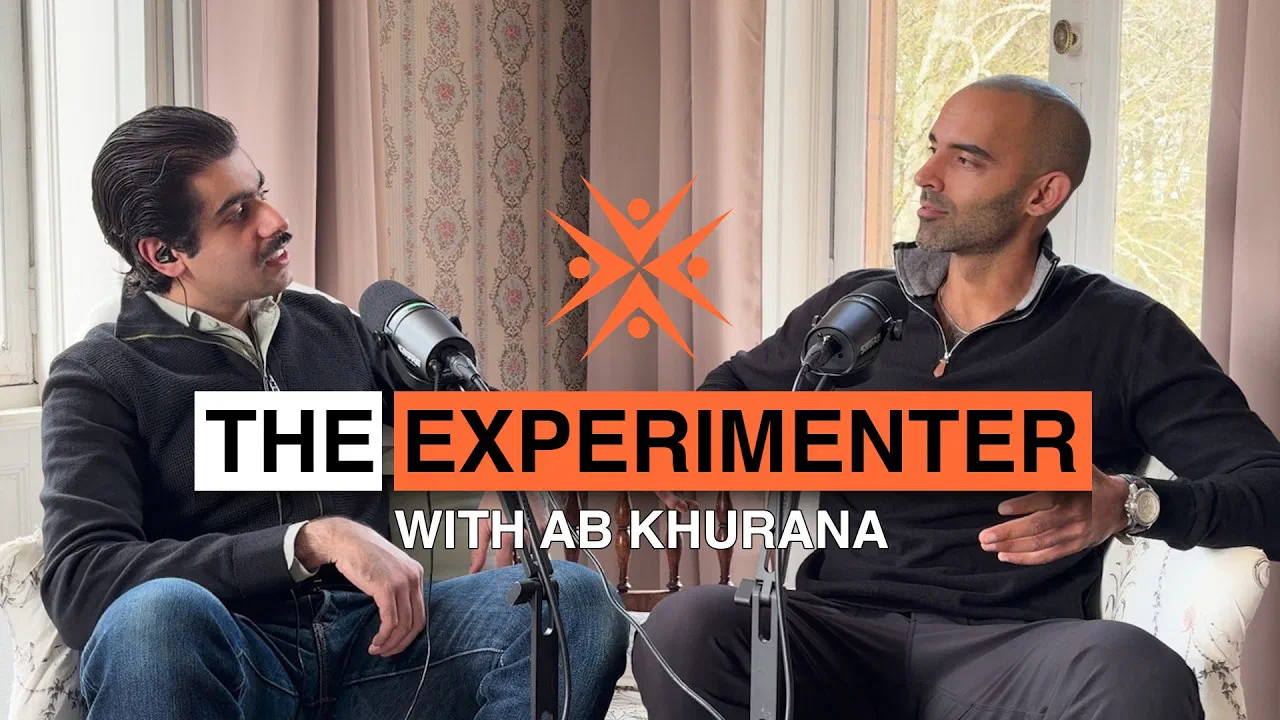
We’re sitting in a French castle talking about Ab Khurana’s two years in San Diego. The lease, the routine, the dating, the sports leagues. Normal life, basically.
“And this sounds like an experiment,” I say. “What did it yield?”
He laughs. “It’s funny to call it an experiment because to most people that’s life. It’s just, hey, get a lease and let’s live here.”
“You’ve been interviewing too many nomads,” he adds.
Fair point. But that’s exactly how Ab thinks. Not settling versus travelling. Not success versus failure. Just trying different things and seeing what works. The timing was right to get a lease in San Diego, so he did. Two years later, the timing was right to leave, so he left. He lives in the present, responding to what makes sense now.
The Timing Calculation #
Two years ago, the timing was right to settle. His friend was moving to San Diego. The city appealed to him. He wanted to explore what stability felt like. So he got a lease, built a routine, made new friends.
Then circumstances shifted. His friend moved out of their shared flat. He wasn’t in a long term relationship. His job stayed remote. And crucially, he’s in his early-to-mid thirties, which means the window for certain experiences hasn’t closed yet. The timing was right to leave.
It’s not about one choice being better than the other. It’s about responding to the moment and taking advantage of the situation as it presents itself.
“I kind of just take advantage of the situation while I’m still in my early 30s or mid 30s before it gets harder to do. If you are going to potentially have a family, or potentially be in a long term relationship, it makes it a little harder.”
This isn’t about running from commitment. It’s about sequencing. Getting certain experiences out of his system now, whilst he has the freedom to do them, so that when commitments do arrive, he won’t spend years wondering what he missed.
There’s something methodical about this. He’s pursuing specific things the twelve-year-old version of himself always wanted to do whilst the variables align to make them possible.
The Science of Self-Knowledge #
The real insight isn’t that Ab experiments. It’s how he uses those experiments to build self-knowledge.
“Having done a few things or experienced a few things that were a little scary, a little new, or just things that the 12 year old me really wanted to do, I know for a fact that that is worth it and it’s worth pursuing that.”
He’s not guessing what brings him contentment. He has empirical evidence.
His framework is simple: experiment with ten things. You’ll love three of them, hate three of them, and feel neutral about four. Once you’ve actually tried them, not just imagined them, you know what to orient your life towards. You know what to avoid. And the rest doesn’t matter much.
This is the opposite of how most people approach life decisions. Most people theorise. They imagine what they’d like, consult friends, read articles, try to predict how they’ll feel. Ab just tries things and observes what happens.
The Tetherball Effect #
The nomad paradox: you need to feel grounded whilst being completely unmoored.
Ab uses a tetherball metaphor. The ball spins wildly, flies in every direction, but it’s attached to the pole with a rope. You can stray as far as you want, but you’re still connected to something fixed. That connection is what lets you experiment without feeling lost.
For Ab, that rope is his parents. He grew up with unconditional love, never doubting whether they loved him, never worrying if their fights meant instability. That foundation, he acknowledges, is luck. Not everyone gets it. But it’s what enables him to travel for years, try risky things, live out of a suitcase, because he knows he’s tethered to something solid.
“That stability was there, that feeling. I think that goes a long way, if you get lucky with that.”
Even without that specific foundation, the grounding can come through other means. Through discovering those three things you love and knowing, no matter where you are physically, that you’re still the person oriented around them.
The grounding isn’t the place. It’s knowing who you are.
The Electron Effect #
Here’s where the conversation gets interesting.
We’re talking about maintaining relationships whilst travelling, and I introduce a physics metaphor: electrons versus neutrons. Neutrons sit in the nucleus, stable and stationary. Electrons whiz around. The chance of an electron hitting a neutron is basically zero. But two electrons colliding? Much higher probability.
Travellers are electrons. Settled people are neutrons. If you’re constantly moving, connecting with people back home who are stable becomes nearly impossible. The collision points don’t align. They’re on holiday for one week a year, visiting places you’ve already left. You’re living your normal life in places they’re treating as special.
But other travellers? You bump into them repeatedly. Same cities, same co-livings, same paths. The collision probability is high.
So Ab has adapted. He hops on his settled friends’ trips when he can, using his flexibility to meet them where they are. He knows how important it is to keep contact with his good friends. And he’s learned something crucial about nomad interactions:
“Oftentimes when I think travellers meet each other, on average, they tend to be more open and unguarded. Each individual is not in their kind of whatever role they play back home with their friends and families. They’re a little untethered.”
You only get one layer deep with most nomad friendships. You’re both leaving soon. But because nomads are more open, that one layer goes deeper than it would back home. Higher frequency of interaction. No roles to play. Less guarded. So even though it’s technically shallow, it feels substantial.
The American who’s always been “the responsible one” back home can be someone else entirely in Mexico. The German who’s stuck in family dynamics back in Hamburg can redefine herself in Thailand. Untethered from context, people show different versions of themselves. Often truer versions.
The Inner Fire Problem #
Ab learned something about comparison that most people don’t figure out until much later.
“It’s quite a recipe for analysis paralysis and discontent to be comparing your own desires to those of others or your own kind of goals or dreams or intentions with those of others.”
He did plenty of comparing when he was younger. It’s natural. But after enough experiments, he realised something: you can learn from others, be inspired by them, but ultimately you have to trust that your inner fire, your guiding gut feeling, is unique to you. It’s okay to trust it rather than seeking validation externally.
The trap isn’t having goals different from others. The trap is thinking your goals need to match someone else’s to be valid.
Some people’s inner fire is building a company. Others want to master an instrument. Ab wants to see an active volcano and learn to scuba dive and be a tourist in India. None of those are more or less legitimate than the others.
Take AI, for instance. Some people wake up excited to experiment with new tools, build workflows, tinker with technology. Ab sees it as a cultural shift, adapts where it makes sense for his work, but doesn’t feel compelled to be at the forefront. “The people who are excited about experimenting with technology, it’s not just that AI came along and turned someone
who is just uninteresting to somebody who’s a tinkerer all of a sudden. You’re already kind of should be of that mind.” They were playing the game before, just a different game.
The key is finding people who encourage your specific fire, not people who try to redirect it toward theirs.
“Finding people that encourage that, friends or relationships, matter. Rare.”
Those people are rare. But nomad communities, he’s found, tend to contain more of them. Because everyone there has made the unusual choice to live differently, they’re less likely to insist you should want what they want.
The Things the Twelve-Year-Old Wanted #
There’s a certain satisfaction in telling your childhood self that you actually did it.
Ab stood at Machu Picchu after hiking the Inca Trail. He watched Volcán de Acatenango erupt from close enough to feel it. He went underwater despite being scared of water his whole life, got certified, and now it’s opened an entire world of exploration he never had access to before.
And India. Being a tourist in the country where he spent his first thirteen years, seeing the parts he never saw, experiencing it fresh.
The Galapagos Islands are next. A safari somewhere in Africa. A month living on a farm through the WWOOF programme, doing physical labour instead of corporate work, practising French or Spanish, making things with his hands instead of pushing pixels on screens.
These aren’t random bucket list items. They’re the specific dreams that survived from childhood into adulthood. The ones that, when tested through experiment, turned out to actually matter to him.
Not everyone’s twelve-year-old dreams are worth pursuing. Some of them are silly. Some don’t survive contact with adult priorities. But the ones that keep coming back, that still feel important decades later? Those are worth taking seriously.
Ab’s taking them seriously. One experiment at a time.
The Experiment Continues #
Eventually, Ab will probably get another lease somewhere. Do another round of the “normal life” experiment. Maybe it’ll stick that time. Maybe the circumstances will be different.
But right now, there are still experiences worth having, fears worth facing, places worth seeing. The twelve-year-old version of himself had a list. The adult version is methodically working through it, learning what actually brings contentment versus what just sounds good in theory.
He’s not running from stability. He’s just not done experimenting yet.
And when you think of life as a series of experiments rather than a series of commitments, everything changes. San Diego wasn’t a failure. Leaving wasn’t giving up. It was choosing to keep exploring whilst the opportunity exists.
Most people spend their lives wondering what would have happened if they’d taken the risk, tried the thing, chased the dream. Ab’s collecting actual answers.
That’s not recklessness. That’s rigour.